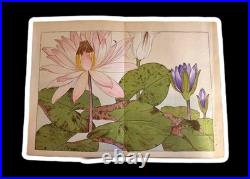


Washi is a traditional, durable Japanese handmade paper typically made from the inner-bark fibers of the kozo (paper mulberry), gampi, or mitsumata plants. Konan’s woodblock prints reflect the abundance and nuances of light, shade, and Western perspective. His works are considered part of the Shin Hanga or “new prints” movement. Each woodblock print was folded and inserted accordion style, leaving normal and original fold lines mid section as well as toned areas from appropriate age. The publication of these prints in 1917 was a very interesting time in Japanese print making, when the old traditional ways of wood block printing were giving way to new western print making technologies such as lithography & photo mechanical printing. Artists and printers in Japan were losing their living and decided to pursue Western markets by reformulating their compositions. Heavily influenced by the Impressionist movement in France, light and shade became incorporated into their art along with Western concepts of perspectiv.