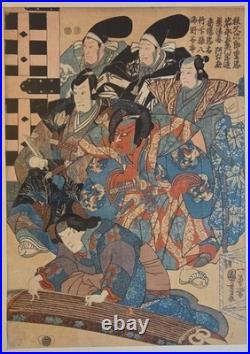
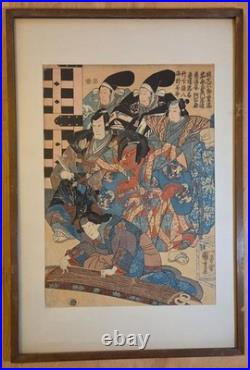
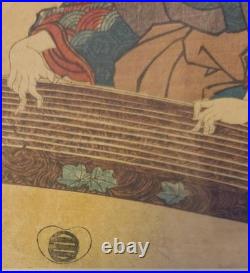
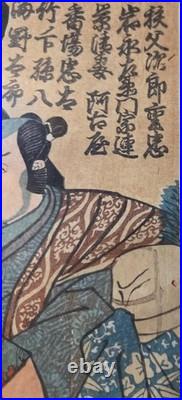
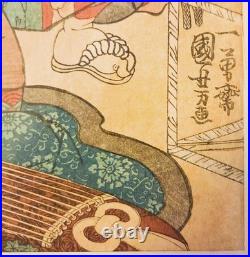


Antique Japanese Woodblock Print by Utagawa Kuniyoshi Kagekiyo and Akoya c. Presented is a beautiful Japanese full oban-size woodblock print created by the renowned artist of the late Edo period, Utagawa Kuniyoshi (1798 – 1861). The print presented depicts a group of samurai listening to a woman playing. A popular Japanese string instrument. The story behind this scene is the famous love story of Kagekiyo and Akoya. This story was the subject of many Kabuki theater plays that are collectively referred to as. Kagekiyo, the hero of the story, is a very renowned warrior of the Taira clan. The Taira (Heiji) and the Minamoto (Genji) clans were rivals and were perpetually at war. Akoya is a high-ranking courtesan and the lover of General Kagekiyo who has gone into hiding after his clan, the Taira, lost to the Minamoto clan in the Genpei War during the late Heian period in Japan. In this play, Akoya, who insists she doesn’t know where Kagekiyo is hiding, is brought before Hatakeyama Shigetada and Iwanaga Saemon Sore who are charged to question and torture her. Rather than bowing to pressure from Iwanaga to use the typically heinous instruments of torture, Shigetada instead demands that Akoya perform on a series of three instruments: koto, shamisen, and kokyu. She pours such loneliness and yearning for Kagekiyo into her music that Shigetada believes she is telling the truth and releases her. We see Akoya playing koto in the middle of the painting, Shigetada at her left and evil Iwanaga Saemon Soren (the one with the red face) who insisted on physical torture, at her right. This is a beautiful sneak peek into the historical Japanese figures immortalized by Kabuki theater plays that were played for centuries. Kuniyoshi was born in Edo (present-day Tokyo) and is known for his dynamic and imaginative prints. Kuniyoshi’s works covered a wide range of subjects, including historical scenes, landscapes, kabuki actors, and mythical creatures. He was particularly skilled in depicting warriors and samurai, often creating dramatic and action-packed compositions. His style was characterized by bold lines, vibrant colors, and intricate details. He had a unique ability to capture the essence of his subjects, infusing them with energy and personality. Kuniyoshi’s prints were highly popular during his lifetime and continue to be admired for their technical skill and storytelling abilities. In addition to his artistic achievements, Kuniyoshi also played a significant role in the development of ukiyo-e as a medium. He was known for his experimentation with new techniques and his willingness to push the boundaries of traditional woodblock printing. Overall, Utagawa Kuniyoshi is considered one of the most innovative and influential ukiyo-e artists of his time, leaving a lasting impact on the genre and inspiring future generations of artists. Many museums in the world have Kuniyoshi works: British Museum Metropolitan Museum of Art in NY Museum of Fine Arts in Boston Tokyo National Museum Museum of Fine Arts in Houston Honolulu Museum of Art and many others. The print was made using the Japanese woodblock technique during the lifetime of the artist. It shows his signature “Ichiyusai Kuniyoshi ga”. Paper METHOD OF PRINTING: Woodblock printing PRINTED: Lifetime printing circa 1849 FRAME SIZE: 18.5″ X 13.5″ PRINT SIZE: 13.75″ X 9.5″ The print is framed in a vintage wooden frame. It was not examined out of frame. Condition: good impression, slight toning, some rubbing, and soiling. Minor worm-holes patching at the bottom. Get images that make Supersized seem small. Track Page Views With.