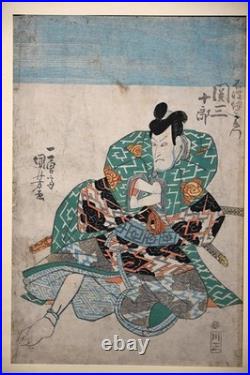
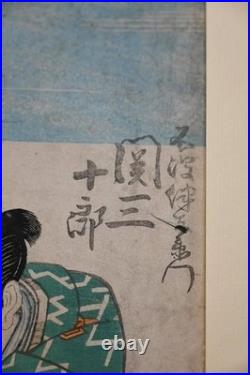
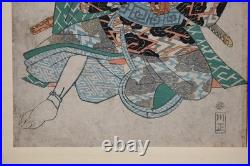
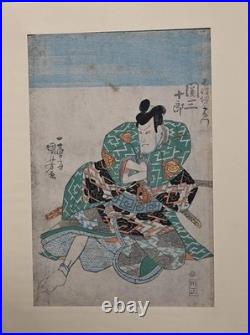
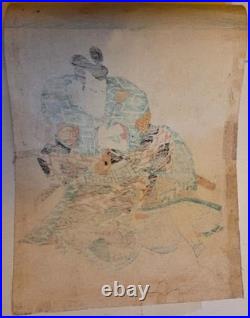

Antique Japanese Woodblock Print by Utagawa Kuniyoshi Samurai Saya-Ate c. Presented is a beautiful Japanese full oban-size woodblock print created by the renowned artist of the late Edo period, Utagawa Kuniyoshi (1798 – 1861). Kuniyoshi was born in Edo (present-day Tokyo) and is known for his dynamic and imaginative prints. Kuniyoshi’s works covered a wide range of subjects, including historical scenes, landscapes, kabuki actors, and mythical creatures. He was particularly skilled in depicting warriors and samurai, often creating dramatic and action-packed compositions. His style was characterized by bold lines, vibrant colors, and intricate details. He had a unique ability to capture the essence of his subjects, infusing them with energy and personality. Kuniyoshi’s prints were highly popular during his lifetime and continue to be admired for their technical skill and storytelling abilities. In addition to his artistic achievements, Kuniyoshi also played a significant role in the development of ukiyo-e as a medium. He was known for his experimentation with new techniques and his willingness to push the boundaries of traditional woodblock printing. Overall, Utagawa Kuniyoshi is considered one of the most innovative and influential ukiyo-e artists of his time, leaving a lasting impact on the genre and inspiring future generations of artists. Many museums in the world have Kuniyoshi works: British Museum Metropolitan Museum of Art in NY Museum of Fine Arts in Boston Tokyo National Museum Museum of Fine Arts in Houston Honolulu Museum of Art and many others The print presented depicts a samurai warrior in fighting position, ready to attack or defend. This is a scene from the Kabuki theater play, “Ukiyozuka Hiyoku no Inazuma” (Inazuma, the Paired Flashes on Ukiyozuka), which premiered in 1823. The action takes place in the Hideoshi times of the mid-1500s. The man is a character from the play called Fuwa Banzaemon, and the scene is called “Saya-ate”. It was the most popular scene of the play that was frequently staged independently. “Saya-ate” (?) is a Japanese term that can refer to a literal or symbolic clash, specifically the clashing of sword scabbards, or a rivalry over a woman. In Kabuki play, this word is associated with the confrontation between Nagoya Sanza and Fuwa Banzaemon, who were both in love with the courtesan Katsuragi. Fuwa Banzaemon is a dandy who leads a shiratsuka-gumi (a group of samurai who have come together and wear flashy, eccentric clothing). He served the Sasaki family of feudal lords, but planned to embezzle them, killed Nagoya Sanza’s father and stole his celebrated sword. This is a beautiful sneak peek into the historical Japanese figures immortalized by Kabuki theater plays that were played for centuries. The print was made using the Japanese woodblock technique during the lifetime of the artist. It shows his signature “Ichiyusai Kuniyoshi ga”. Publisher: Kawaguchiya Shozo Censor’s Seal and Date: kiwame, 1830s AUTHOR: Utagawa Kuniyoshi TITLE: Seki Sanjuro II as Fuwa Banzaemon from the scene “Saya-ate” CREATED: c. Paper METHOD OF PRINTING: Woodblock printing PRINTED: Lifetime printing circa 1830 PRINT SIZE: Full oban size 15″ X 10.25″ The print is mounted to a simple mat 18″ X 13.5″. Condition: good impression, slight fading, some rubbing, and soiling. Minor worm-holes patching at the bottom. Auctiva offers Free Image Hosting and Editing. Track Page Views With.