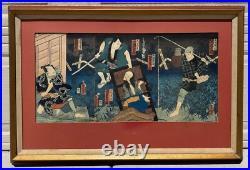
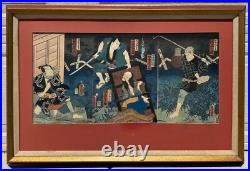
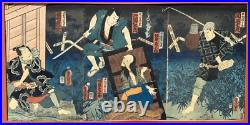
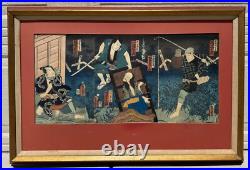
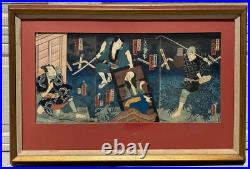
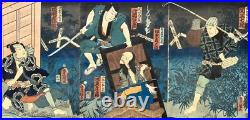
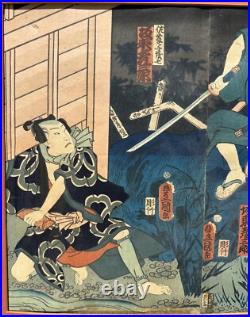
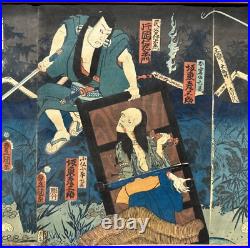
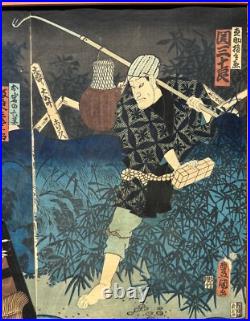
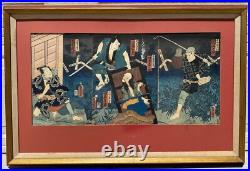
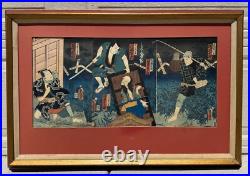
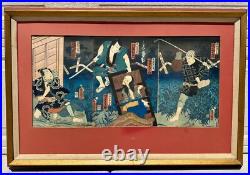
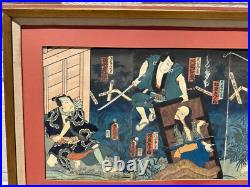
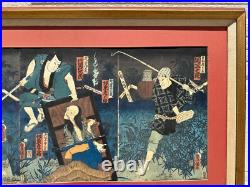
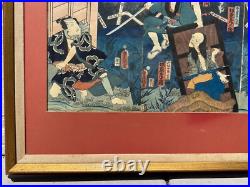
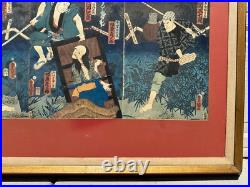
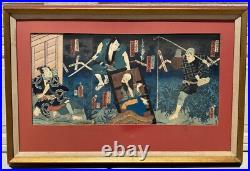
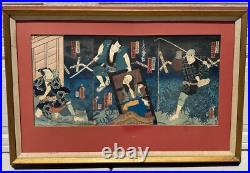
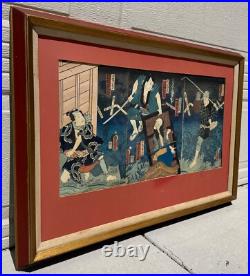
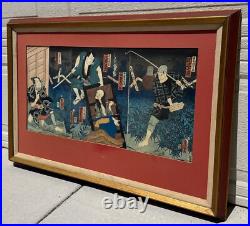
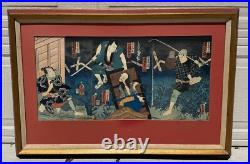


Antique Japanese Woodblock triptych print. Scene from Onbobori: Yotsuya Ghost Story (Tokaido Yotsuya Kaidan), Act III By Utagawa Kunisada (Toyokuni III), 1861. (The Ghost Story of Yotsuya). Created in the 7th month of 1861 (Ansei 8), the piece portrays the chilling Onbobori scene-a climactic moment of supernatural vengeance that epitomizes Edo-period ghost storytelling. Artist: Utagawa Kunisada (Toyokuni III), signed as “Toyokuni ga” within a toshidama cartouche. Publisher: Ebisuya Shoshichi (Kinshodo), active c. Carver: Yokokawa Takejiro, seal “Hori Take”. Medium: Polychrome woodblock print triptych on Japanese washi paper. Date: July 1861 (Ansei 8). Framed Dimensions: 24″ H × 36″ W (triptych) x 2 1/2 inch depth, visible print area approx. 13.5″ H × 27.5″ W. Frame: Wood with brick-toned matting, no glass. Depicted Scene & Characters. Left Panel: Bando Hikosaburo V as Sato Yomoshichi. Center Panel: Kataoka Nizaemon VII as Tamiya Iemon, haunted by the ghost of Oiwa (also portrayed by Bando Hikosaburo V). Right Panel: Bando Hikosaburo V as the ghost of Kobotoke Kohei. Set by a riverside, this moment portrays the tormented Iemon confronted by the spectral figures of Oiwa and Kohei-victims of his betrayal and murder. Their bodies, nailed to a door and discarded in the river, now return in ghostly form, bringing moral reckoning to a chilling crescendo. Kunisada’s masterful composition highlights his expertise in. (actor prints), blending intense emotional expression, detailed costume rendering, and possible high-end printing effects like blind embossing. The triptych format enhances the narrative flow and theatrical impact of the work. Historical and Cultural Significance. Penned by Tsuruya Nanboku IV in 1825, is one of Japan’s most enduring ghost stories, originally staged alongside. This print captures the Edo-era fascination with karmic justice and the supernatural, central themes in kabuki theater and ukiyo-e art. Rarity & Subject Matter: A less common Kunisada triptych featuring the iconic Yotsuya Kaidan and supernatural imagery. Provenance & Craftsmanship: Published by a noted house (Ebisuya Shoshichi) and carved by a respected artisan (Yokokawa Takejiro). Framing & Condition: Good condition overall with typical age-related wear minimal; framed presentation enhances value no glass. However, does look like one area has been repaired; framed gilt gold and brick color frame. Please note the matt border brick and tan does show some wear. Kunisada, also known as Toyokuni III, was born in the Honjo district of Edo as Kunisada Tsunoda. Kunisada’s family owned a small hereditary ferryboat service. Though his father, an amateur poet, died when Kunisada was a child, the family business provided some financial security. During his childhood, he showed considerable promise in painting and drawing. Due to strong familial ties with literary and theatrical circles, he spent time studying actor portraits. At age 14, he was admitted to study under Toyokuni, head of the Utagawa school. Kunisada’s woodblock print work embodies the characteristics of the Utagawa school, focusing on traditional subjects such as kabuki, bijin (beautiful women), shunga (erotic prints), and historical prints. His first known print dates to 1807, his first illustrated book to 1808. Kunisada’s art career took off from the beginning. Many of his works became overnight successes and he was considered the “star attraction” of the Utagawa school. He signed his works “Kunisada, ” sometimes with the studio names of Gototei and Kochoro affixed. In 1844, he adopted the name of his teacher and became Toyokuni III. Kunisada passed away in 1864 in the same neighborhood that he was born. He was 70 years old. Kunisada was a highly popular, and the most active, ukiyo-e print artist of the 19th century. In his time, his reputation surpassed those of his contemporaries Hiroshige and Kuniyoshi.