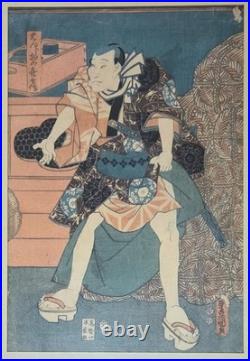
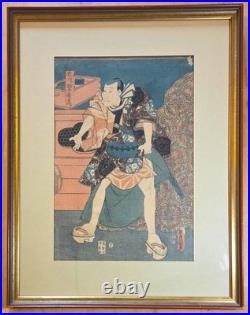
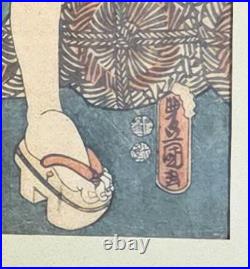
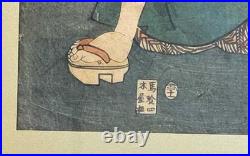
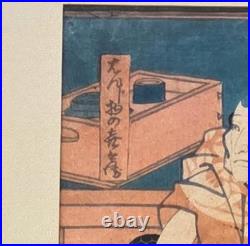

Antique Original Japanese Woodblock Print by Kunisada -Samurai Kabuki Scene- Framed c. Presented is a beautiful Japanese full oban-size original woodblock print created by the renowned artist of the late Edo period, Utagawa Kunisada (1786 – 1864), also known as Kunisada I and Toyokuni III. The print presented shows a man with a sword, apparently of a samurai rank. He is engaged in a dispute with someone using his body position to defend something – probably to secure a pile of parcels behind him. Most likely, it is a scene from a Kabuki play, but I was unable to determine the exact name and the plot of the play. In many cases, pictures of scenes from theater plays show us a lot of different and interesting things about the culture of Edo-period Japan. The way people behaved, the way they dress, and the environment, both inside and outside their homes. Especially when the images are created by the most skilled and talented artists like Kunisada. Utagawa Kunisada was a prolific woodblock print artist mostly known for his pictures of beautiful women (bijinga) and kabuki actors’ prints (yakusha-e). Kunisada’s pictures reflect the culture of Japan in the years leading up to the country’s opening to the West. His first book illustrations were published in 1807 and his first actor portrait the following year. Alongside theatrical scenes and courtesans, yakusha-e was his preferred genre amidst all his popular and extensive output. As he painted a large number of these, continuing the stout realism of his teacher, he acquired the nickname’Yakusha-e no Kunisada’ – Kunisada, the actor painter. In his numerous bijinga, he clung to the ideal of beauty prevalent at the time. Most of the women portrayed were courtesans from Yoshiwara, the regulated red-light district of the city. Many museums in the world have Kunisada works: British Museum Metropolitan Museum of Art in NY Museum of Fine Arts in Boston Tokyo National Museum Museum of Fine Arts in Houston Honolulu Museum of Art and many others The print was made using the Japanese woodblock technique during Kunisada’s lifetime. Signed with artist’s signature “Toyokuni ga”, in. Cartouche and sealed with censor and publisher’s seals. The print is framed in a good quality modern wooden frame. AUTHOR: Utagawa Kunisada I (Toyokuni III) TITLE: Samurai – Scene from a Kabuki Play (Descriptive title) CREATED: c. Paper METHOD OF PRINTING: Woodblock printing PRINTED: Lifetime printing circa early 1860s PRINT SIZE (sight): Full oban size 14″ X 9.5″ FRAME SIZE: 20.5″ X 15.75″. The condition is very good. Good detail and colors with some minor fading. A wormhole in the upper right. The frame shows some very minimal wear. The print was not examined outside of frame. Get images that make Supersized seem small. Track Page Views With.